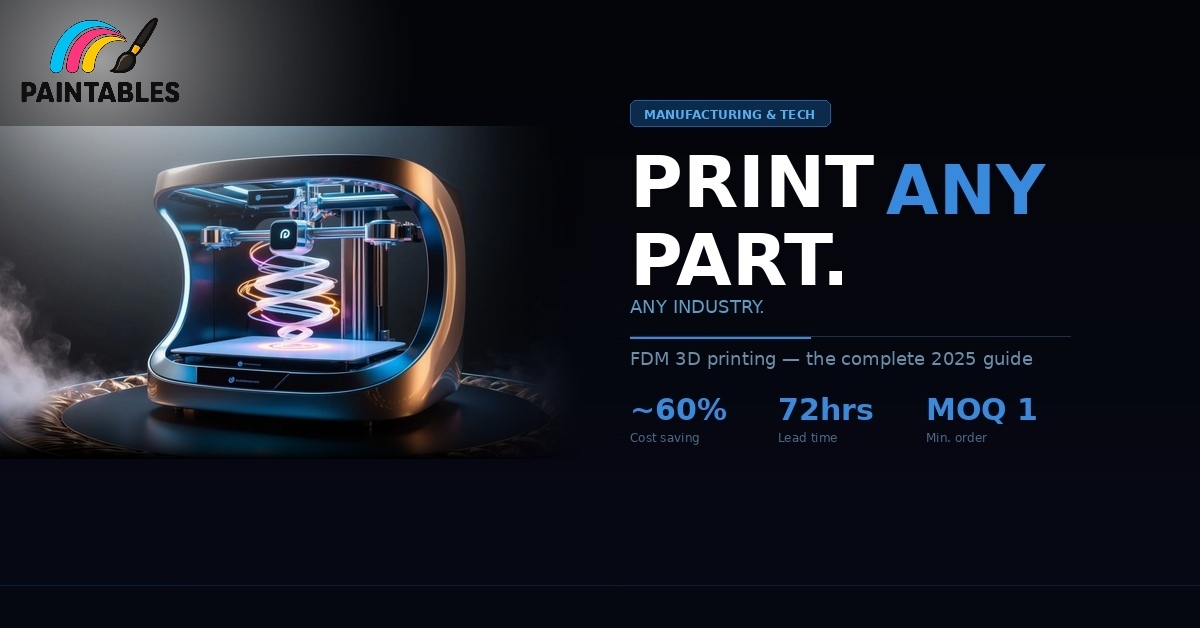
How FDM 3D Printing Is Reshaping the Way the World Makes Things
Home » 3D Printing » How FDM 3D Printing Is Reshaping the Way the World Makes Things
How FDM 3D Printing Is Reshaping the Way the World Makes Things
FDM 3D printing has quietly revolutionised how homes, workshops, and entire industries source custom parts. From a cracked dishwasher bracket to a custom car manifold, discover how this technology works, which materials hold up in the real world, and why businesses across every sector are ditching back-order lists for an on-demand print farm. Your complete beginner-to-intermediate guide — with costs, print times, material comparisons, and the most common questions answered.
How FDM 3D Printing Is Reshaping the Way the World Makes Things
From a cracked dishwasher bracket to a custom car manifold — the machine that once lived only in aerospace labs is now on your workbench. Here's everything you need to know.
📖 12 min read🎯 Beginner to intermediate🗓️ Updated 2025
Imagine designing a part at 9 pm, pressing print, and holding it in your hands before breakfast. No factory. No minimum order quantity. No waiting weeks for a supplier in another country. That's not a futuristic promise — it's FDM 3D printing today.
⬡ What exactly is FDM printing?
Fused Deposition Modelling (FDM) is the most widely used form of 3D printing. A spool of plastic filament is fed into a heated nozzle that melts it down to roughly the consistency of hot glue, and a robotic arm traces precise paths — layer by layer — until a three-dimensional object emerges from thin air.
The digital blueprint is a standard 3D file (typically .STL or .STEP), sliced by software into hundreds or thousands of horizontal layers. Each layer bonds to the one beneath it. When complete, you have a fully functional part — not a model, not a prototype (unless you want one) — a real, usable object.
How a print goes from file to part
1
Design
CAD software or a downloaded file (.STL/.STEP)
2
Slice
Software converts to layer-by-layer toolpaths
3
Print
Nozzle melts filament and traces each layer
4
Cool
Layers fuse and harden as the bed lowers
5
Finish
Remove supports, sand, paint, or use as-is
The whole process can take anywhere from 20 minutes for a small bracket to 30+ hours for a large complex assembly. And here's the thing that changes everything: the machine doesn't care whether it's printing item number one or item number ten thousand. The cost per part stays roughly constant — unlike injection moulding, where you need to recoup a R50,000–R500,000 mould first.
✦ The real superpower: made exactly for you
Mass manufacturing is brilliant at producing millions of identical parts cheaply. But the moment you need something different — a slightly wider bracket, a part that no longer exists, a component in a colour that doesn't ship to South Africa — the system breaks down. You get told "we don't make that," or you wait three months, or you pay a machinist R4,000 for a two-hour job.
FDM printing collapses that gap entirely. Custom geometry costs nothing extra. A bracket designed for your exact appliance, a cable clip that fits your specific cable diameter, a replacement knob for a discontinued microwave — all of these are now a few hours of print time away.
~80%
cost saving vs traditional machining for one-off parts
24 hrs
typical turnaround from design to finished part
0
minimum order quantity — print one if that's all you need
What's often overlooked is the design freedom. Traditional manufacturing imposes constraints — parts need to be machinable, mouldable, assemblable by human hands. FDM prints internal channels, organic curves, and interlocking geometries that would be impossible or prohibitively expensive any other way.
◈ Across every industry — real examples
This isn't a technology for specialist labs. Here are the sectors that are quietly being transformed right now:
🏠
Household appliances
Replacement clips, knobs, drawer runners, fan mounts — parts that go obsolete the moment a model is discontinued.
🚗
Motor vehicles
Custom brackets, air intake components, interior trim, jigs for panel alignment, and race-car aero parts.
🏥
Medical devices
Prosthetic limb sockets, surgical guides, custom orthotics — all fitted exactly to a patient's anatomy.
Irrigation nozzle adaptors, sensor housings, tractor component jigs — on-site, same day, without a parts supplier.
🏗️
Architecture
Scale models, custom facade elements, bespoke window furniture, and structural prototypes for approval submissions.
The automotive use case is particularly striking. Modern vehicles contain thousands of small plastic components — clips, holders, trim pieces, sensor mounts. When a part becomes unavailable (discontinued models, grey-imports, classic car restorations), FDM printing lets a workshop reproduce it precisely from a scan or a hand measurement in an afternoon. Some workshops have already replaced entire back-order catalogues with an on-demand print farm.
◉ "But is it actually strong enough?"
This is the question almost everyone asks first — and rightly so. The answer depends almost entirely on the material chosen:
Material
Best for
Strength
Temp resistance
PLA
Prototypes, decorative, low-stress parts
Moderate
Low ~60°C
PETG
Food-safe containers, mechanical parts, outdoors
Good
Medium ~80°C
ABS / ASA
Under-bonnet automotive, UV-exposed parts
Good
High ~100°C
Nylon (PA12)
Functional gears, snap-fits, structural brackets
Very good
High ~120°C
TPU
Seals, gaskets, flexible grips, bumpers
Flexible
Medium ~80°C
Carbon-fibre composite
Structural, motorsport, lightweight tooling
Exceptional
Very high
A well-printed Nylon or carbon-fibre composite part can carry structural loads that would embarrass many traditionally manufactured alternatives — at a fraction of the weight. The key is matching the material to the job. Printing a bracket to hold a shelf in a hot car with PLA will fail. Printing the same bracket in ASA will last years.
Print orientation matters too — FDM parts are slightly stronger along the X/Y plane than the Z axis (vertical), because layer adhesion is the weakest bond. A skilled designer accounts for this by orienting the most critical stress direction along the strongest axis.
? Questions you're probably already asking
Click any question to expand the answer.
It depends on size, material, and whether you own a printer or use a service. A small household part (like an appliance clip) in PLA costs R15–R60 in filament on a home printer. A service bureau will charge R80–R400 for the same part. A large automotive bracket in engineering-grade material might run R200–R1,500 at a bureau — still far cheaper than a machined equivalent. Entry-level FDM printers start at around R3,000–R6,000 and pay for themselves quickly if you print regularly.
Small parts (think a key fob or a cable clip) take 20–45 minutes. A medium bracket or housing might be 2–6 hours. Large assemblies or high-detail prints can run 12–36 hours or more. Layer height is the main variable — thicker layers are faster but less detailed; thinner layers produce finer finishes and take longer. Most functional parts use 0.2mm layers, which balances speed and quality well.
Generally yes, with basic precautions. PLA emits very low levels of particles and is considered the safest filament. ABS and some engineering materials emit more fumes — always ensure ventilation or use an enclosed printer with a HEPA filter. The nozzle and heated bed reach temperatures of 200–250°C, so standard workshop safety applies. Most modern printers include thermal runaway protection and auto-shutoff. Leave it printing overnight? Absolutely — millions do.
Yes, this is one of FDM's most proven applications. Nylon, PETG, and carbon-composite filaments produce parts that handle real mechanical loads. Printed threads work well in low-to-medium torque applications. Gears printed in Nylon can run for thousands of cycles. The key is design — thicker walls, correct infill percentage (50–80% for structural parts), and choosing the right orientation on the build plate. Many professional workshops now print their own jigs, fixtures, and tooling.
You don't have to. Sites like Printables, Thingiverse, and GrabCAD have millions of free downloadable designs — from appliance spares to automotive brackets. Many designers also offer commissions. AI-assisted CAD tools are making design increasingly accessible too. If you can describe the part you need, chances are either it already exists as a file online, or someone can model it for you for a modest fee.
FDM and SLA serve different needs. FDM wins on material variety, part size, and cost for functional, structural, or large parts. Resin (SLA/MSLA) wins on surface finish and fine detail — dental models, jewellery, miniatures. For the vast majority of industrial and household applications, FDM's material strength, build volume, and low cost per gram make it the practical choice. Most workshops run FDM for functional parts and resin for cosmetic or highly detailed components.
Yes — with the right material choice. Standard PLA softens at around 60°C, which means it can warp on a sunny car dashboard. ASA (weather and UV resistant) and ABS handle under-bonnet temperatures comfortably. PETG works well for outdoor applications with UV exposure. For continuous high-heat environments (engine bays, exhaust proximity), specialised materials like PA-CF (carbon-fibre filled Nylon) or PEEK are available, though they require more advanced printers.
Want to go deeper? Whether you're choosing your first printer, designing a specific part, or sourcing a print service — drop a comment below or get in touch.
Have a part you need printed? Describe it in the comments — the community can help point you in the right direction.